EE Configuration Pilot
- Tetouan
Production / Quality / Security / Maintenance - Secteur Automotive / Motorcycles / Cycles - Automotive / Motorcycles / Cycles
- Senior (5 to 10 years)
- 1 job(s) in Without region - Morocco
- Master or PhD Minimum
Need for objectivity Tenacity Organization Rationalism Respect of the rules
- Permanent contract
- Teleworking : No


Company :
ALTEN MOROCCO, a branch of the world leader in engineering and technology consulting, was created in 2008 and is present in Fez, Rabat, Tetouan, and Casablanca. It currently has over 2200 employees and aims for a center of excellence with 3300 ALTEN employees by the end of 2027. It is now a strategic player in supporting the professional development of engineers.
Our mission: to meet the technological ambitions of our clients - major international contractors - in the automotive, rail, R&D and IT, telecommunications, and media sectors.
Joining ALTEN Morocco means joining an ecosystem of excellence and benefiting from:
• A personalized and evolving career path
• An ambitious skills development policy
• A stimulating, collaborative, and meaningful work environment
Discover the testimonial of Hajar Bououd, HR Director and Communication at ALTEN Morocco in the magazine Challenge Maroc by clicking here: https://bit.ly/3QMntIc
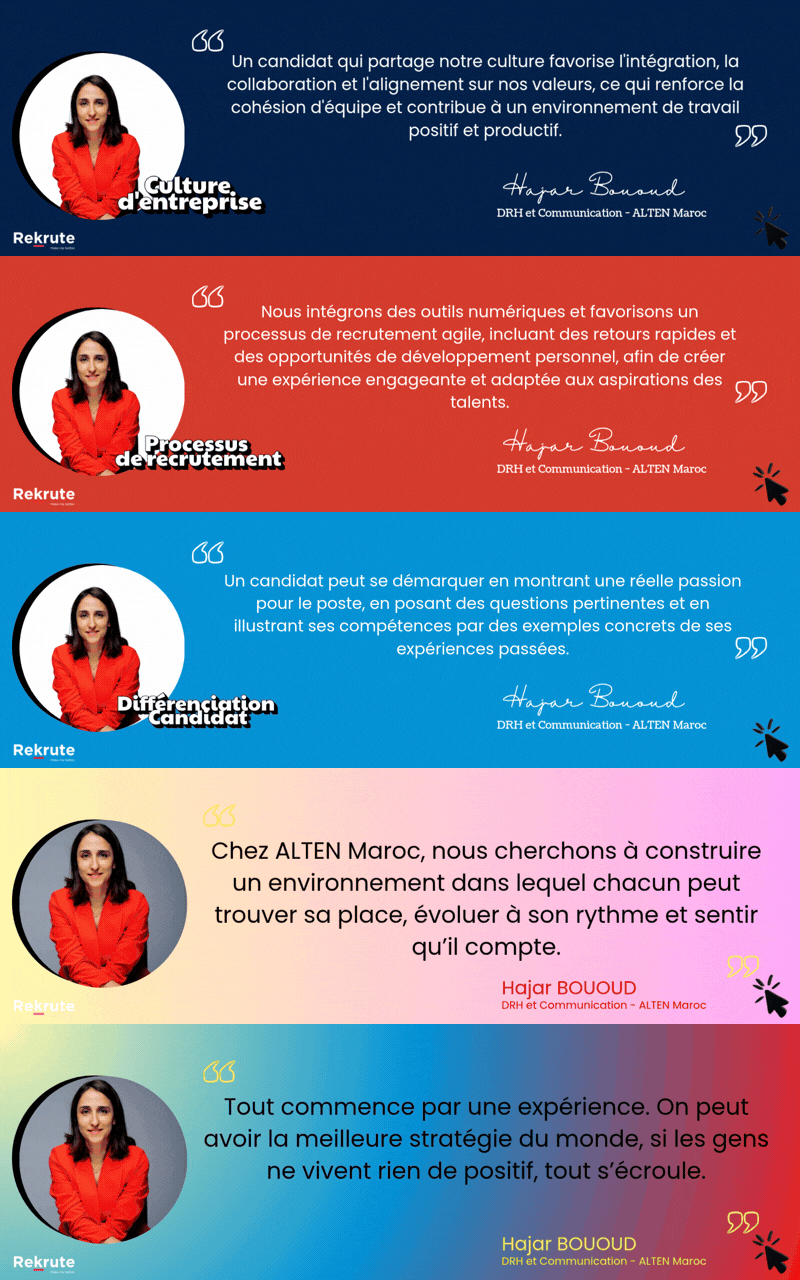
Company culture :
Alten Maroc is defined by a deeply collaborative culture, focused on people, trust, and strong team support, with hands-on managers who guide and develop talent.
This environment is enhanced by a strong drive for innovation, encouraging creativity, initiative, and experimentation across projects.
A structured and disciplined organization ensures efficiency, rigor, and quality in engineering delivery.
Performance and ambition are part of the culture as well, supporting collective success while maintaining a positive and caring atmosphere.
Job :
- Activity of "Baselining"
Creation of the initial baseline:
- This baseline represents the initial state of all configurable elements, including specifications, plans, hardware components, software, technical documents, etc.
Change management:
- Modifications can be proposed at any time and can concern any element of the project, such as a design change, a software update, a component change, etc.
Comparison with the initial baseline:
- At each stage of the baselining process, changes are compared to the initial baseline to assess their impact and compliance with project specifications and requirements.
Baseline update:
- When a change is approved and validated, it is integrated into the next baseline to create a new reference. Through this process, the baseline continuously evolves throughout the project.
Traceability and consistency:
- The baseline serves as the reference for tracking changes applied to components. It ensures traceability, meaning the ability to follow the history of changes over time, and maintains consistency between different parts of the project.
Verification and audit:
- Configuration management, including the creation of baselines, is subject to periodic checks and audits to ensure compliance with standards, regulations, and project requirements.
2. Activity of "Change" (change management)
Identification of the change request:
- The process begins with the identification of a change request, for example, from the software development team, users who encountered a problem with their vehicle, or a regulatory compliance audit.
Evaluation of the change request:
- Once identified, the request is evaluated based on several criteria: its relevance, its impact on the components and systems concerned, and the criticality of the associated risks. This initial analysis determines whether the request is acceptable and can be submitted for approval.
Creation of the change proposal:
- If the request is deemed relevant, a technical solution proposal is developed. This must include detailed information on the nature of the modification, its objective, the configurable parameters affected, and the risks associated with its implementation.
Review and approval:
- The change proposal is reviewed and evaluated during a decision-making committee. The requestor presents the solution to experts who analyze its feasibility, relevance, and impacts.
Change implementation:
- Once approved, the change can be implemented. In the case of an electronic control unit (ECU), this may involve modifying the embedded software code, the electronic microcomponent, or updating calibration or configuration files.
Testing and verification:
- After implementation, non-regression tests are carried out to verify that the modification has been correctly integrated, that it has not generated new malfunctions, and that it meets project requirements.
Validation:
- Following successful tests and verifications, the change is validated to confirm that it meets the project's needs and can be integrated into the overall configuration.
Documentation:
- All stages of the change management process (requests, proposals, approvals, tests, verifications, and validations) are fully documented to ensure complete traceability.
Required profile :
- Industrial engineer diploma or equivalent
- Experience: 3 to 5 years in the automotive sector
- Knowledge in mechanics: Solid background in mechanical and production engineering, strength of materials, Machine Directive, welded structures
- Technical English
Head office address :
Parc Fès Shore Parc- Route sidi Hrazem - Fès - Maroc
Desired personality traits :
Need for objectivity Tenacity Organization Rationalism Respect of the rules
Here you can find a recommendation rate for this vacancy, as well as information on how to promote your application. Log in / Register to view this personalised information.
ReKrute offers you this new personality test to help you get to know yourself better and make the most of your applications. Take it now, it only takes 5 minutes maximum.