

New study in partnership with BCG: Almost half of Moroccan executives want to expatriate internationally

Almost half of Moroccan executives want to expatriate internationally
- ReKrute, in collaboration with the Boston Consulting Group and The Network, unveils the results of its global survey on international mobility conducted with over 150,000 executives.
- Moroccans are intrinsically more attached to their country than the rest of the world (53% vs 33%).
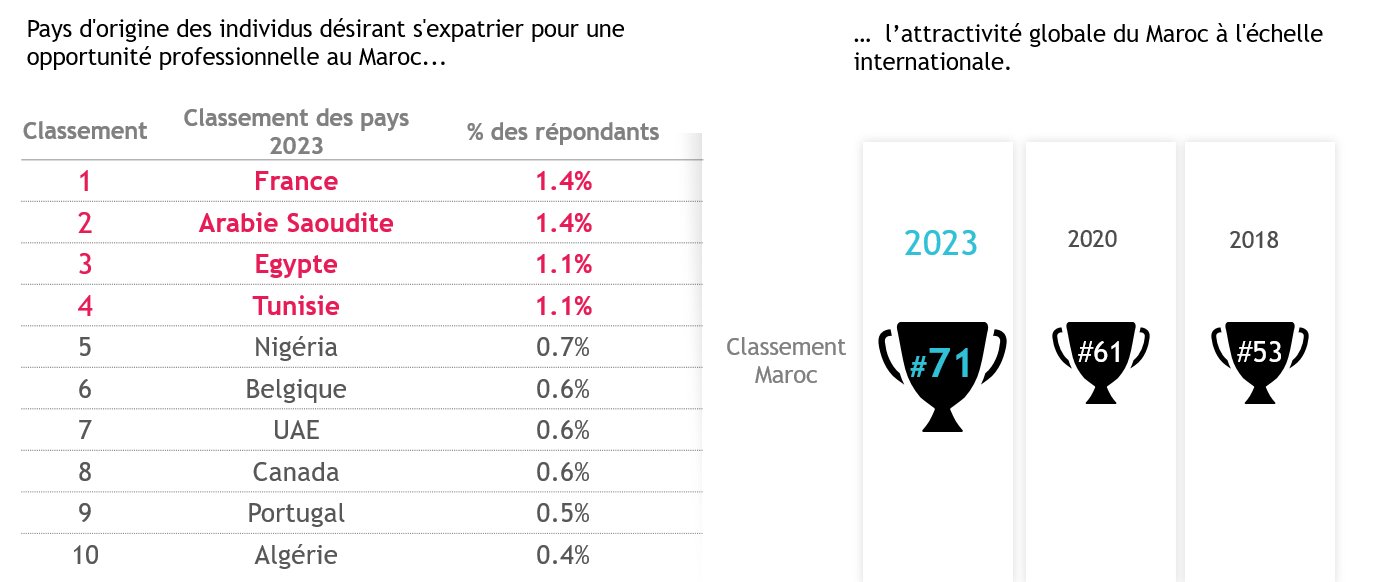
- The French and Saudis are the most attracted to expatriation in Morocco, closely followed by Egyptians and Tunisians.
- Moroccan expatriation is desired mainly for financial reasons and a better quality of life.
- However, this desire for expatriation is less strong than in 2020 (-16 points).
In Morocco, international mobility and returning home captivate both employers and employees, particularly in a context of increasing globalization of the job market. However, despite the increased ease of travel and many opportunities abroad, a recent study reveals the levers for retaining employees and better attracting Moroccan and international expatriates.
This study was conducted by Boston Consulting Group (BCG), The Network, the international network of leading job portals worldwide, and ReKrute. The survey transparently presents the expectations of 150,000 executives in over 185 countries, including 1097 in Morocco.
Anglo-Saxon countries remain among the most attractive in the world
The survey "International Mobility: What are the expectations of executives?" first reveals some major global trends, particularly concerning the countries and cities most attractive to executives globally. This year, the TOP 5 is as follows: Australia comes first, followed by the United States, Canada, the United Kingdom, and Germany. The TOP 3 has remained unchanged since 2020, even if Australia has taken 1st place, leaving its 3rd place to Canada this year. There is also a drop in attractiveness of France, which in 3 years has gone from the 6th most attractive country in the world to 9th in 2023. Others, such as Spain, have reappeared in the TOP 10 in last position after disappearing from the ranking in 2020.
The most attractive cities in the world for executives are, in decreasing order of attractiveness: London in 1st, Amsterdam in 2nd, Dubai and Abu Dhabi in 3rd and 4th position almost equally, then New York in 5th. Note Barcelona in 8th position, which allowed Spain to return to the ranking this year.
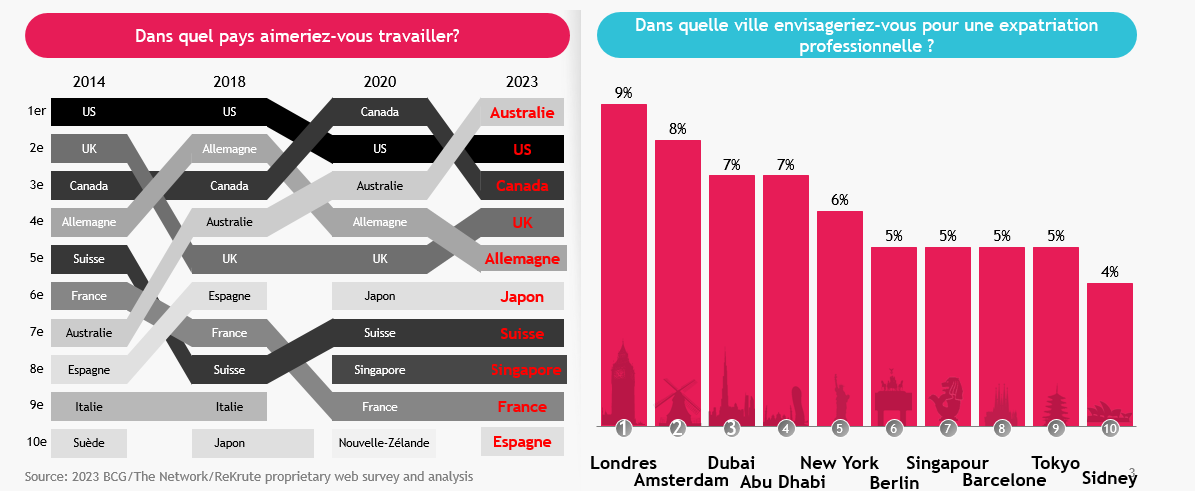
It should be noted that international mobility is an essential reality to be taken into account by all HR departments, either to recruit better by looking for pools where necessary, or to better retain their employees.
Dream of expatriation of global executives
It is noted that 63% of global executives dream of expatriation! And even if this score has dropped by 15 points since 2018, they still represent the wish of more than 1 executive in 2 in the world.
Attractiveness of Morocco in 2023 and reasons for wanting to leave the country
Ranked in the TOP 100 of the most attractive countries in the world, Morocco arrives in 2023 in 71st position. Morocco loses 10 places compared to 2020. However, it continues to strongly attract, mainly French and Saudi people equally, closely followed by Egyptians and Tunisians. Those who follow are, in order: Nigeria, Belgium, the United Arab Emirates, Canada, Portugal, and finally Algeria.
We measure here that ultimately, the countries attracted to Morocco are largely those that recruit many Moroccans, such as France, Saudi Arabia, Belgium, or even Canada. Is this a sign that Moroccans want to return home as soon as conditions allow?
Also note the strong attractiveness of Morocco in the Maghreb countries!
Most attractive countries for Moroccans
The favorite international destinations for Moroccans to work are, in order of attractiveness, Canada, France, then Germany. Note that the TOP 3 in 2020 was the same. This year, however, France came in 2nd position, taking the place of Germany, which in turn moved to 3rd in 2023.
Also read: 7 out of 10 employees are actively looking for a job in Morocco
Anglo-Saxon countries, unlike other executives in the world, attract Moroccan executives but without any significant difference since 2020. The United States comes in 4th, while the United Kingdom remains in 10th position.
It is also interesting to note that Qatar and the United Arab Emirates have completely disappeared this year from the list of the most attractive countries for Moroccans!
Obstacles and advantages for expatriation
Even if in 2023 52% of Moroccan professionals wish to work abroad (and this still represents more than twice the average scores obtained abroad with a score of 23%), there is a decrease compared to the last study in 2020 and its 68% who wished to expatriate.
Also read: Only 8% of Moroccans are loyal to their company, interview with Alexandra Montant
This clearly reveals that fewer and fewer Moroccan executives wish to expatriate, finding more and more answers to their expectations locally, which is very positive!
Despite an evident desire for mobility, several barriers remain for Moroccan executives, including strong family and cultural attachments. Thus, 53% of executives refuse to leave because they are emotionally attached to Morocco. This score is still 20 points higher than the global average, which only reaches 33%!
Family is also essential to their well-being. Thus, 41% of executives refuse expatriation because their family cannot accompany them. This represents the 2nd most important criterion for refusal. The Moroccan executive is courageous by nature otherwise, the majority of obstacles to international expatriation are not for him. We can mention here, for example, the language barrier, concerns about mobility, or even the cost of relocation.
What emerges from the analysis is ultimately that Moroccans do not wish to expatriate and if, locally, HR departments offered them real career assets, the expatriation rate would drop drastically!
Reasons for expatriation
The study thus highlights that the two main reasons that push Moroccans to expatriation, and which arrive equally with 62% of the vote, are financial and economic reasons and a better quality of life. This second reason is even more essential for Moroccans than for the rest of the world (only 55% of votes worldwide). These two arguments are closely followed, in decreasing order, by a better social and health system first, 16 points higher than the world average, considerations related to career then, and then by personal fulfillment and cultural experience (47% of votes).
It is also important to note that 29% of executives wishing to expatriate do so because they wish to work in a more inclusive company, offering equal opportunities to people. Worldwide, this only comes in 10th position with 19% of the votes.
However, be careful, because Moroccans who wish to leave dream more than their counterparts internationally, of long-term expatriation. Thus, 42% wish to expatriate for a long period vs only 29% worldwide.
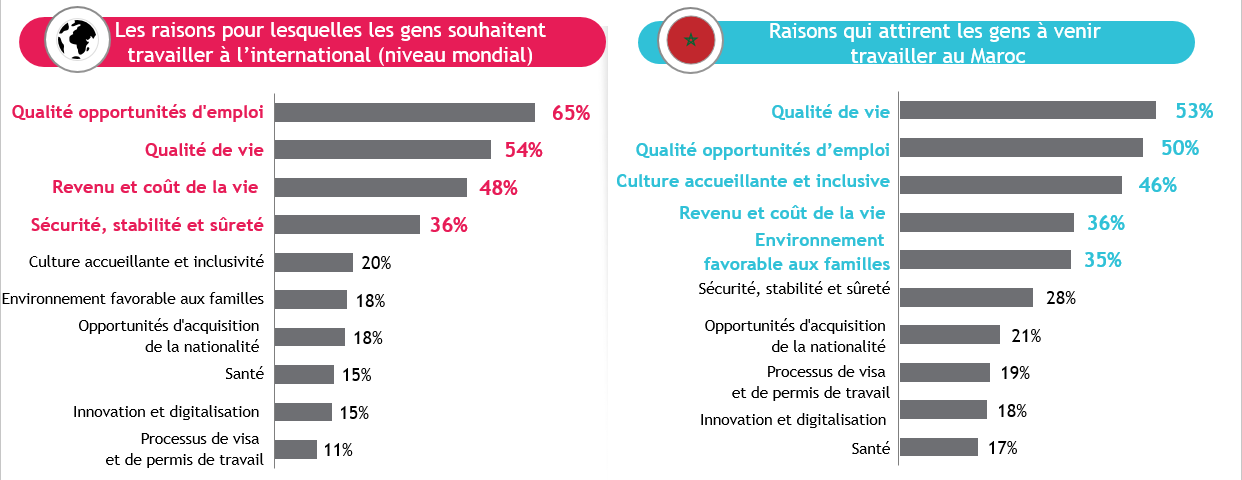
These elements underline the importance for international and national recruiters to understand and adapt their offers and processes to the specific needs of Moroccan talents.
Expectations and challenges in the expatriation process
Moroccan executives who leave have specific expectations towards their future international employers, particularly in terms of administrative support and acclimatization. 82% of respondents expect assistance with visas and work permits. Housing assistance is expected by 63% of Moroccans, below the global average of 79%.
To attract internationals, local HR departments must prioritize, almost equally, housing assistance, assistance with visas and work permits (78% also), relocation assistance, and finally language support and training.

Research methodology
This study was conducted from January to April 2024, involving 150,000 professionals spread across more than 185 countries. This international survey was carried out by the Boston Consulting Group (BCG) and The Network, with the participation of ReKrute for the Moroccan segment, including 1096 local respondents.
The data collected during this study includes detailed information on the mobility preferences of executives, segmented by gender, age, education level, industry, professional experience, and function. This comprehensive methodology allows for an in-depth analysis of trends in international mobility among professionals worldwide.
