

UM6P CEDOC- IWRI & GSMI: Underground hydraulic aquifer systems of the piedmont of the Atlas of Marra - Benguerir
Secteur de l’entreprise : Enseignement / Formation
ENTREPRISE :
Mohammed VI Polytechnic University is an institution dedicated to research and innovation in Africa and aims to position itself among world-renowned universities in its fields The University is engaged in economic and human development and puts research and innovation at the forefront of African development. A mechanism that enables it to consolidate Morocco’s frontline position in these fields, in a unique partnership-based approach and boosting skills training relevant for the future of Africa. Located in the municipality of Benguerir, in the very heart of the Green City, Mohammed VI Polytechnic University aspires to leave its mark nationally, continentally, and globally.
Ce que nos collaborateurs aiment le plus chez nous ❤ : Consultez nos avis certifiés
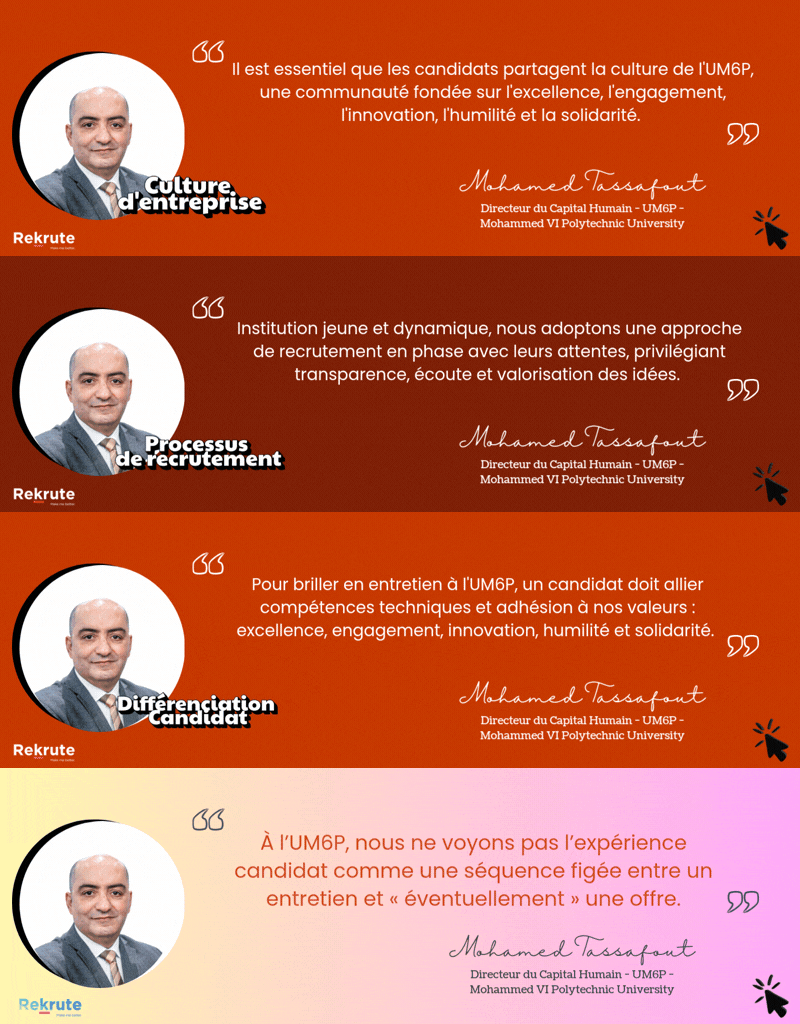
Culture de l'entreprise :
UM6P – Université Mohammed VI Polytechnique se caractérise par une culture fortement orientée innovation, où la créativité, l’expérimentation et l’audace intellectuelle constituent des piliers essentiels. L’université encourage l’initiative, l’ouverture d’esprit et l’autonomie, dans un environnement stimulant tourné vers la recherche, l’entrepreneuriat et l’impact. Cette dynamique innovante est enrichie par une dimension coopérative solide, valorisant la collaboration, le partage des savoirs et le développement humain. Une orientation vers la performance et l’excellence complète l’ensemble, tandis que les processus formels restent volontairement plus légers pour préserver l’agilité.
Poste :
Background
With the succession of years of drought, surface water resources in the piedmont of the northern slope of the central High Atlas of Marrakech have become increasingly scarce. The exploitation of shallow aquifers and deep aquifers is being considered as a solution. The northern slope of the High Atlas of Marrakech, which is the subject of the proposed thesis, is drained by mountain tributaries of the Tensift river. In the Atlas piedmont, these tributaries develop terraces and sometimes extensive alluvial plains along the valleys of Ourika, Amzmiz, Tadart, and Tassaout. These areas are often used for agriculture by the local communities, particularly for citrus fruits (pomegranate, apricot, plum, vine, etc.), as well as olive trees and vegetables. Moreover, these valleys also attract significant investments in tourism.
In this regard, our planned research work focuses on the hydrogeophysical study of the terrace and alluvial plain aquifers, as well as the Eocene aquifer system in the study area. We aim to implement a research and evaluation approach to assess the importance of water resources in these different aquifers and optimize their sustainable exploitation to safeguard and support agricultural and tourism activities in the region.
On a geophysical level, several field survey campaigns using advanced techniques are requested to identify and image the aquifers in each study sector. The main geophysical methods considered include Electrical Resistivity Tomography (ERT), Magnetic Resonance Sounding (RMS), and FullWaver (FW). The objective is to characterize the significance and extent of the studied aquifers and indirectly determine their hydrodynamic parameters and storage capacity. These parameters will also be validated through direct pumping tests and subsequently integrated into the hydrogeological models of the studied aquifers.
Key duties
The proposed research includes the following tasks:
- The use of several geophysics methods to characterize the stratigraphy, geometry, geological characteristics and structural analysis for shallow aquifers.
- The use of geophysics methods to assess the porosity (water content) and the permeability of groundwater.
- Experimental field work for groundwater recharge and groundwater-surface water interactions characterisation
- Accurate estimate of groundwater storage and productivity using in situ measurements
- Assessment of the climate change impact on streamflow and groundwater storage
- The use of artificial intelligence approaches for groundwater modelling
In addition, the PhD student will be expected to work in collaboration with the IWRI and GSMI teams or other UM6P departments, in particular other PhD students, both in the field and in the laboratory.
Criteria of the candidate
Master's or engineer degree in earth or environmental sciences or equivalent topic related to water resources management under global changes.
Skills
Candidate should be/have :
- Familiar with geophysics techniques and methods
- Goode knowledge in hydrogeology and hydrology disciplines
- Good knowledge in groundwater modelling
- Good skills in computer programming tools (e.g., Matlab, python, R), GIS techniques and mathematical modelling.
- Knowledge in applying machine learning approaches
- Familiar with remote sensing techniques and long-term data analysis
- Good English and French skills
Profil recherché :
Criteria of the candidate
Master's or engineer degree in earth or environmental sciences or equivalent topic related to water resources management under global changes.
Skills
Candidate should be/have :
- Familiar with geophysics techniques and methods
- Goode knowledge in hydrogeology and hydrology disciplines
- Good knowledge in groundwater modelling
- Good skills in computer programming tools (e.g., Matlab, python, R), GIS techniques and mathematical modelling.
- Knowledge in applying machine learning approaches
- Familiar with remote sensing techniques and long-term data analysis
- Good English and French skills
Découvre si ce poste est fait pour toi
Passe le test de personnalité gratuit ReKrute et obtiens instantanément ton score de compatibilité avec ce poste et avec la culture de plus de 150 entreprises du marché.
